Why Book Publishers Should Take Another Look at Meta Ads
For most book publishers, Amazon Ads should remain the largest and most scalable part of the digital advertising mix. Consumers go to Amazon ready to shop, and Amazon has impressive data about what they search for, browse, and buy.
We aren't suggesting publishers spend less on Amazon, but we do believe many publishers are leaving growth on the table by underusing Facebook and Instagram.
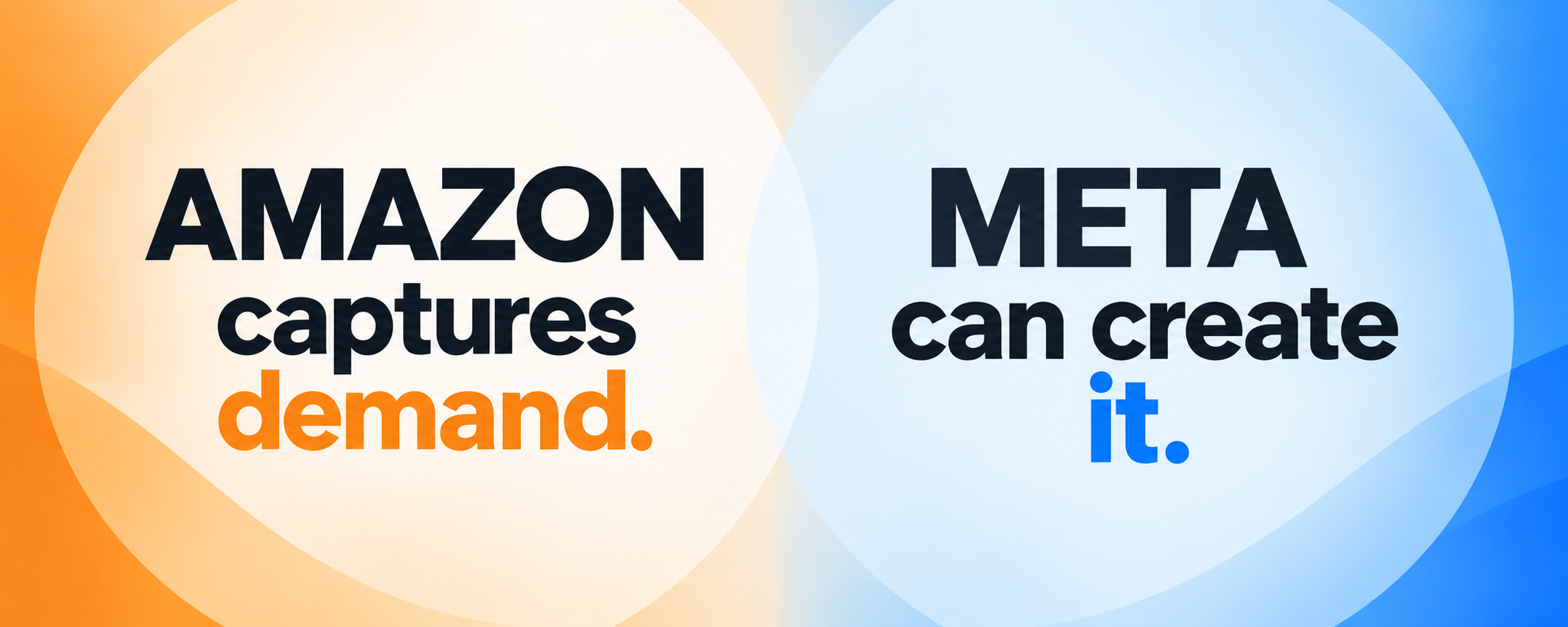
The reason comes down to a fundamental difference between the platforms: Amazon is exceptionally good at capturing existing demand. Meta can help create new demand.
Readers Don't Need to Be Shopping for a Book
Amazon's greatest advertising advantage is intent. Someone searching for a particular author, genre, subject or comparable title is an extremely valuable prospect. But that also limits the opportunity. Before Amazon can convert demand, that demand generally has to exist.
People spend far more of their day consuming content on Facebook and Instagram than they do actively shopping for books. That gives Meta many more opportunities to introduce a book to someone who wasn't looking for it, and books are particularly well suited to that kind of discovery.
Most books fall within an impulse-friendly price range. A compelling cover, premise, quote, review, endorsement, illustration or video can take someone from "I've never heard of this" to "I want to read this" remarkably quickly.
You can't search for a book you don't know exists. Meta can introduce it.
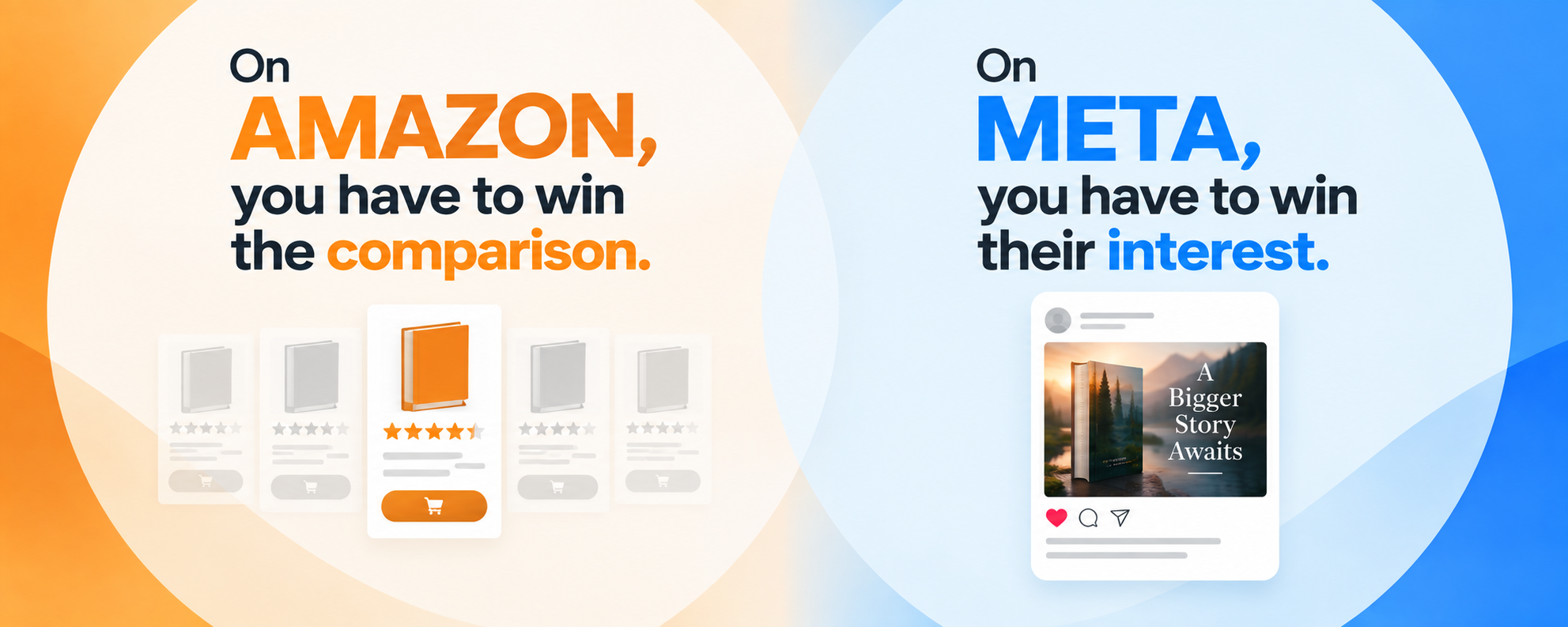
On Amazon, You Have to Win the Comparison
Getting an ad in front of the right Amazon shopper is only part of the battle. Your book may immediately be surrounded by competing organic and sponsored listings. The shopper can compare covers, titles, prices, discounts, star ratings, and review counts within seconds.
That can put otherwise excellent books at a disadvantage.
A book with 25 reviews may compete against one with 5,000. A $17.99 book may sit beside a heavily discounted bestseller. Amazon's expanding price-history features can even show consumers that a product was cheaper recently—potentially giving them another reason to postpone a purchase.
Meta creates a very different first impression.
The reader initially sees what you choose to show them. Maybe it's the premise. Maybe it's an incredible interior spread. Maybe it's three starred reviews, an author endorsement, a page-turn video or one irresistible line from the book.
The reader isn't simultaneously comparing it with ten other books.
On Amazon, you have to win the comparison. On Meta, you have to win their interest.
New Releases Can Especially Benefit
This distinction can be particularly important for new books. A new release has no sales history, reviews, or advertising history, and often little or no discounting. Meanwhile, it is competing against books with years of accumulated sales, reviews and authority.
Meta gives a new release something closer to a clean slate.
A reader responding to a great piece of creative doesn't necessarily know that the book was released three days ago and has six reviews. The book gets an opportunity to succeed on the strength of the proposition itself.
And, in addition to D2C sales, demand generated on Meta can ultimately help build the sales, searches, reviews, and awareness that strengthen performance on Amazon.
Meta Has More Data Than Your Targeting Box Suggests
Another outdated assumption is that successful Facebook advertising depends on finding the perfect interest audience.
Increasingly, Meta's algorithms can learn who is most likely to respond based on enormous amounts of behavioral data combined with the conversion signals advertisers provide. In that environment, creative itself becomes part of the targeting.
An ad for a lift-the-flap book for preschoolers naturally attracts different people than an ad for a literary horror novel. Meta can learn from who stops, clicks, and ultimately purchases.
That means creative doesn't just sell the book, it helps find the audience.
It also makes Meta a useful testing environment. Publishers can test different hooks, benefits, audiences and creative concepts and learn what actually motivates consumers. Those insights can then improve Amazon A+, product descriptions, email, retailer marketing and other campaigns.
Direct-to-Consumer Has Changed
Historically, there was an obvious objection to sending social traffic to a publisher's website: Amazon's checkout was simply easier. That gap has narrowed.
Apple Pay, Google Pay, Shop Pay and other accelerated checkout options can turn the path from discovery to purchase into a few taps on a phone.
Buying directly from publishers also appeals to some consumers who want to support authors, publishers, and smaller businesses directly or simply prefer an alternative to Amazon.
And publishers gain something important in return: a direct customer relationship, first-party data and opportunities for email marketing, retargeting, bundles, special editions, and future purchases.
But none of this works if the experience after the click is poor.
A publisher serious about DTC advertising needs a strong mobile experience, properly implemented Meta Pixel and Conversions API (CAPI) tracking, digital wallets, a fast checkout, reasonable shipping, no surprise handling fees, and quick fulfillment.
Meta Ads can't outperform the experience you send people to.
Creative Matters More Than Publishers Sometimes Realize
The same applies to the advertising itself. Putting a book cover on a background with "Available Now" isn't a Meta strategy.
Successful campaigns require creative built for the environment: strong hooks, multiple concepts and formats, compelling copy, and a clear reason someone should care about the book right now.
Publishers actually have tremendous raw material: excerpts, illustrations, reviews, endorsements, awards, author stories, page-through videos, characters, problems the book solves, gift occasions, and seasonal hooks.
If a publisher tried a handful of generic Facebook ads several years ago and they didn't work, that doesn't necessarily tell us whether Meta can sell its books today. It may simply tell us that those ads didn't work.
Don't Make Meta Compete With Amazon
Perhaps the biggest mistake is thinking publishers have to choose between the two. They don't. For most publishers, Amazon Ads will continue to provide substantially greater scale. Amazon remains an extraordinary place to advertise books.
Meta serves a different role.
It can reach readers before they search. It can introduce unknown books. It can give new releases and backlist titles a fresh first impression. It can generate direct sales. And even when someone doesn't buy immediately, Meta can create awareness that leads to a later Amazon search or purchase.
That last point also makes measurement more complicated. A reader might discover a book on Instagram today and buy it from Amazon three days later. Amazon may record an organic sale—or even attribute it to an Amazon ad—while Meta receives none of the credit for creating the initial demand.
That's why publishers should look beyond platform-reported ROAS and consider what happens to total sales when advertising is added.
The opportunity isn't to replace Amazon with Facebook and Instagram. It's to use each platform for what it does best.
Amazon captures demand. Meta creates more of it.
Publishers have spent years building increasingly sophisticated Amazon advertising programs. Meta deserves the same disciplined opportunity to prove what it can do.
How Amplify Can Help
The right advertising mix will look different for every publisher and every catalog. At Amplify, we help book publishers determine where Amazon, Meta, and other channels fit—and how to use them together to drive sustainable growth.
If you're reconsidering your advertising strategy or wondering whether there are opportunities you're not fully capturing today, we'd welcome a conversation to explore what a partnership could look like.