Book Description Best Practices: How to Write Copy That Gets Found and Sells More Books
A great book description does two jobs at the same time: it helps readers discover your book, and it persuades them to buy it.
Unfortunately, many book descriptions only accomplish one of those goals. Some are packed with keywords but feel awkward and difficult to read. Others are beautifully written but lack the SEO structure needed to help readers find them in the first place.
The most effective book descriptions balance both; they combine clear, compelling copy with SEO best practices and reader-friendly formatting.
Why Most Book Descriptions Underperform
When we audit book descriptions, we frequently see the same issues:
Descriptions that are too short to communicate value
Descriptions that are too long and overwhelming
Large blocks of text that discourage reading
Clever copy that sacrifices clarity
Weak SEO optimization
Heavy reliance on AI-generated content without sufficient editing
The reality is that readers don’t consume online copy the way they read a book; they scan first and read second. If your description isn’t easy to skim, many potential buyers will never engage with your message.
The Four Elements of an Effective Book Description
Strong book descriptions combine four essential components:
Clear messaging
Compelling copy
Proper SEO optimization
Snackable formatting
The first two are the art of copywriting. The second two are the science.
When all four work together, your description becomes easier to discover and more likely to convert visitors into buyers.
What Is “Snackable” Copy?
Snackable copy is content that readers can quickly scan and understand.
Most readers don’t carefully read every word of a product page. Instead, they scan headlines, bullets, and short paragraphs looking for reasons to keep reading. That’s why formatting is just as important as the words themselves.
Consider the difference between these two approaches:
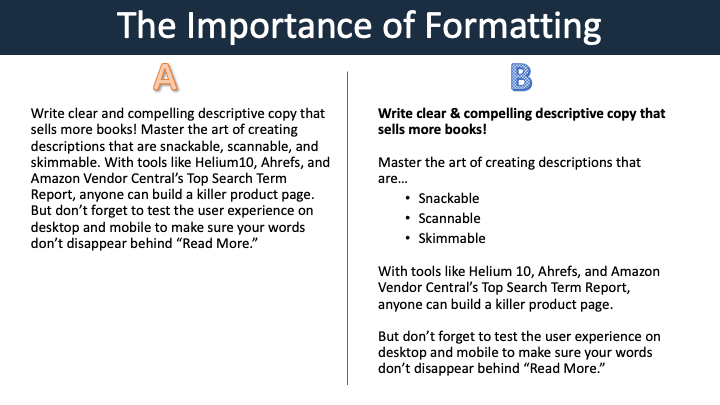
Both examples contain exactly the same information. The difference is that the version on the right uses formatting to guide the reader’s eye. Short paragraphs, bullet points, and visual hierarchy make the content easier to scan, understand, and remember.
The goal isn’t to write less. It’s to present information in a way that helps readers process it quickly.
Use Formatting for Emphasis—Not Decoration
Bold text, ALL CAPS, and underlining can be powerful tools for guiding a reader’s attention, but only when used sparingly. The purpose of formatting is to create contrast. If everything is emphasized, nothing stands out.
One common mistake is making an entire headline, bridge paragraph, and bullet list bold or ALL CAPS. When multiple sections compete for attention, readers stop noticing the emphasis altogether. Instead, reserve formatting for the moments that matter most.
Use bold text to highlight a key feature, benefit, or phrase within a paragraph. Consider bolding an endorser’s name so it is easy to spot while scanning, or emphasize the most compelling phrase within a longer endorsement. Underlining and ALL CAPS can also be effective in limited situations, but should be used less frequently than bold text. The goal is not to decorate the page; it’s to direct the reader’s eye to the information most likely to influence a purchase decision.
The Anatomy of a High-Converting Book Description
Instead of presenting a block of text, break information into a structure that naturally guides the eye:
A bold headline
A bridge (short transition paragraph)
A concise bullet list
Additional descriptive copy
This format works well not only for Amazon product pages but also for publisher websites, email campaigns, social media content, and sales materials.
1. Start with a Strong Headline
The headline is the first thing readers see. Its purpose is simple: convince someone to keep reading.
Strong headline approaches include:
Highlighting bestseller status
Referencing awards or honors
Featuring a compelling endorsement
Making a clear promise to the reader
Presenting a powerful benefit or unique selling proposition
This is usually not the place for clever wordplay. Clarity outperforms creativity when readers are making quick decisions.
2. Add a Short Bridge Paragraph
After the headline, include a brief paragraph of one or two sentences. This section creates a smooth transition into your bullet points and provides context without overwhelming the reader.
Effective bridge paragraphs often:
Use active language
Focus on reader benefits
Create curiosity
Set up the value communicated in the bullets
Keep it concise. The goal is to maintain momentum while guiding the eye to the bullet list.
3. Use Strategic Bullet Points
Bullet points are one of the most effective ways to make descriptions easier to scan. Rather than telling the entire story, bullets should highlight key information quickly.
Good bullet point topics include:
Features
Benefits
Intended audience
Discussion questions
Study guides or bonus content
Contributors
Age or grade ranges
Calls to action
A good rule of thumb is to limit yourself to four or five bullets. Too many bullets can make the description feel like an outline rather than persuasive copy. Keep each bullet short (8-10 words, 40-80 characters per bullet) and, as a rule, only use one bullet list per book description.
4. Expand with Additional Details
After you’ve captured attention and delivered the highlights, use the remaining space to provide more detail.
This section can include:
Expanded benefits
Audience information
Endorsements
Contributor details
Gift-giving occasions
Additional keyword variations
This is also where you can naturally reinforce important SEO terms without keyword stuffing.
Don’t Be Afraid of Repetition
Many publishers avoid repeating information because they worry readers will find it redundant. In practice, the opposite is often true. Readers rarely consume every section of a product page. They skim selectively, focusing on the areas that catch their attention.
That means important information can—and often should—appear in multiple locations, including:
Headlines/Taglines
Editorial reviews
About the Author sections
A+ Content
Brand Story modules
The exception is backend keyword fields, where unnecessary duplication should be avoided.
Using Endorsements Effectively
Endorsements can be one of the strongest assets in a book description.
Consider including:
Quotes from recognized influencers
Endorsements from respected organizations
Testimonials that clearly communicate your book’s value
Short endorsements typically perform best. In some cases, a powerful endorsement can even serve as the headline itself.
Strengthening the About the Author Section
Many publishers treat the author bio as an afterthought. Instead, view it as an additional marketing opportunity. A strong author section can:
Highlight bestselling titles (even if by other publishers)
Establish credibility (awards/honors received)
Demonstrate expertise (positions held, years in field of study)
Connect with the target audience (if it is a children’s book or a resource for parents, say something about the author’s own children)
Whenever possible, tailor the bio to the book’s topic and intended reader.
The Bottom Line
The best book descriptions don’t force a choice between SEO and persuasive writing; they balance both. By combining clear messaging, compelling copy, strong keyword optimization, and snackable formatting, publishers can improve discoverability while giving readers a better buying experience.
If your current descriptions consist of long paragraphs, weak headlines, or minimal formatting, small changes can make a significant difference in both visibility and conversion.
Whether you’re launching a new title or improving the performance of an existing catalog, professional copy optimization can have a meaningful impact on discoverability and conversion. Amplify Marketing Services offers book description audits, reformatting, and optimization services designed to improve readability, SEO, and shopper engagement.
These services can be provided as standalone projects or incorporated into a broader partnership that includes metadata optimization, backend keyword research, Amazon Ads and multi-channel ad management, and ongoing growth strategy. If you’re unsure whether your current descriptions are helping or hurting performance, our team can evaluate them and recommend opportunities for improvement.