Why Amazon Reviews Are Critical for Book Sales—and How to Get Them Right
Amazon book reviews are not a vanity metric, they are one of the most powerful levers publishers have to influence visibility, click-through rate, and conversion. In many cases, they determine whether a book succeeds or stalls, especially in the first few weeks after launch.
Why Reviews Matter So Much
At the most basic level, reviews create social proof. When a reader sees that others have read and enjoyed a book, it reduces hesitation and speeds up the decision-making process. Instead of wondering “Is this worth my time?”, the answer is already implied by the crowd.
But the impact goes far beyond perception:
Better click-through rates: When browsing search results, categories, or carousels, readers primarily see three things: the cover, title, and reviews. Reviews heavily influence whether they click.
Higher conversion rates: A strong rating (4.6+ stars) with a healthy number of reviews gives readers confidence to purchase quickly.
Algorithmic advantage: Amazon is more likely to surface books organically, and give Amazon Ads more impressions, when the product detail page shows strong engagement signals like reviews and ratings.
Competitive positioning: When competing titles have significantly more reviews or higher ratings, they win attention, even if your book is better.
In fact, one of the first two things readers typically click after landing on a book’s product page is:
Reviews
Read Sample
They want to know what others think and what they think themselves before trusting anything the publisher says in the description or A+ Content.
Before You Try to Get Reviews, Understand the Rules
Because reviews carry so much weight, Amazon treats them as part of its trust infrastructure. That means they are heavily monitored, and any attempt to manipulate them, intentionally or not, can lead to serious consequences.
This includes reviews from:
Authors, employees, or anyone with a financial interest
Friends or family members
Anyone receiving compensation or incentives
Violations can result in:
Review removal
Loss of all reviews on a title
Suppressed visibility or listing issues
Account-level warnings or suspension
Even worse, Amazon may remove legitimate reviews along with flagged ones, effectively resetting a book’s credibility overnight (see complete list of rules here).
For publishers, this means one thing: reviews must be earned, not engineered. A strong review strategy is essential, but it must always operate within Amazon’s guidelines to protect long-term performance.
The Rating and Volume Benchmarks That Matter
For most books, a 4.6-star average rating should be treated as the minimum threshold. Below that, conversion rates begin to drop noticeably.
In addition to rating, review volume matters. A practical framework:
Week 1 goal: 10+ reviews
Short-term milestones: 25 → 50 → 100
Long-term targets: 1,000+ reviews (while maintaining a 4.6+ rating)
Early momentum is especially critical. New release campaigns are often derailed by:
No reviews
Too few reviews
A single low rating (e.g., 1-star) dragging the average below 4.6
Backlist titles are equally affected. If competing books in the same category have significantly more reviews or stronger ratings, they will consistently outperform yours in both organic placement and paid campaigns.
4 Ways to Get More Amazon Book Reviews
1. Author-Led Review Solicitation (Most Important)
The most effective and scalable way to generate reviews is through the author. Authors should be encouraged to consistently and intentionally ask for reviews across all platforms, including:
Social media posts
Social media bios
Email newsletters
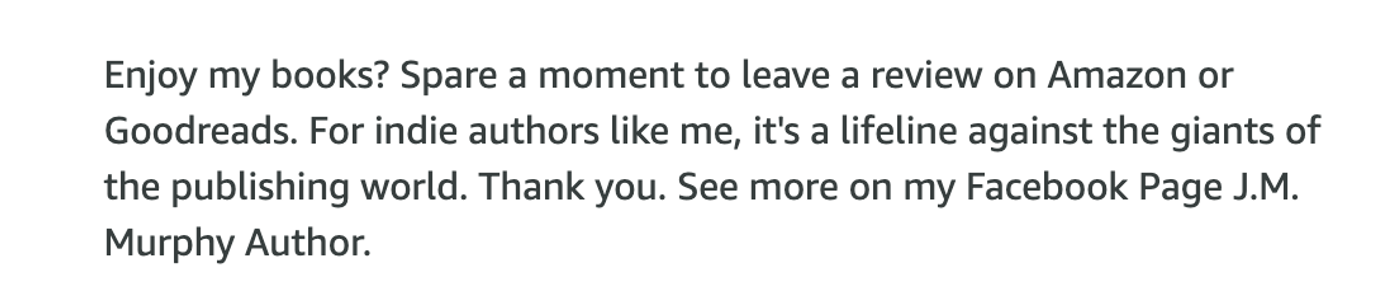
Author Central profile (see example)
Speaking engagements
Video content (YouTube, Instagram, TikTok, etc.)
The key is positioning. Requests should not feel self-serving. Instead, frame them as helping other readers:
“Please leave a review on Amazon so other readers can know if the book is right for them.”
This shifts the motivation from helping the author to helping the community.
Just as important is what authors communicate when making the ask. Many readers don’t realize that they do not need to purchase a book on Amazon to leave a review, which can significantly limit review volume if left unaddressed.
Publishers should ensure authors:
Clearly state that reviews can be left regardless of where the book was purchased
Provide simple instructions for leaving a review (with and without an Amazon purchase)
Include direct links to the review section wherever possible
Encourage Goodreads reviews as a secondary action, since they appear on Amazon product pages and contribute to overall perception
Publishers should also proactively educate authors on Amazon’s review policies. Without guidance, authors may unintentionally solicit reviews from friends, family, or close contacts, putting the book at risk. Clear guardrails ensure review efforts are both effective and compliant.
Provide authors with:
Clear do’s and don’ts for Amazon review compliance to ensure outreach is effective and within guidelines
Pre-written social copy
Branded creative assets
Talking points for live events
Email templates
Also reinforce consistency. This should not be a one-time ask, but an ongoing habit.
2. Launch Teams (High Effort, High Reward)
Launch teams can generate early reviews, especially within the critical first week, but they require significant coordination.
Key considerations:
Recruit engaged readers in advance
Provide early access (ARCs)
Set clear expectations (including leaving a review during launch week)
Offer meaningful incentives or exclusive access (bonus content, private Q&A sessions with the author, signed copies)
Challenges:
Time-intensive to manage
Difficult to scale
Requires accountability on both the author and participants
Still, when executed well, launch teams are one of the best ways to hit early review thresholds.
3. Amazon Vine (Use Carefully)
Amazon Vine allows you to distribute copies to reviewers, but it comes with tradeoffs:
You cannot control who receives the book
Reviewers may not be your target audience
Negative reviews are possible (and common)
Reviews are labeled as Vine reviews, which can carry less trust with some shoppers
Vine can help with volume, but it is not a precision tool, and can backfire.
4. NetGalley (Still Relevant)
NetGalley remains a viable channel for distributing advance review copies, particularly for traditional publishing workflows. It helps generate early awareness and reviews, though quality and relevance of reviewers can vary.
Final Takeaway
Amazon reviews are one of the most visible and influential elements of a book’s success. They impact discoverability, advertising performance, and—most importantly—whether a reader decides to buy.
A strong review strategy should focus on:
Achieving 4.6+ stars
Building early review velocity
Scaling to key volume milestones
Activating authors as primary drivers
Maintaining strict policy compliance
Without reviews, even the best books struggle to gain traction. With them, everything else—visibility, clicks, and sales—becomes significantly easier.