Easter is the #2 Sales Season for Children’s Books…
And Most of the Demand Doesn’t Even Include Searches for “Easter”
For book publishers in the children’s book category, Easter represents one of the most significant and often underleveraged seasonal sales opportunities of the year. While Christmas remains the dominant gift-giving season, Easter has firmly established itself as the second-largest seasonal opportunity for broader children’s book sales, not only because of strong gift intent but also because of the unusually long shopping window that surrounds the holiday. What makes Easter especially powerful, and often misunderstood, is that much of its demand does not show up in searches that include the word “Easter” at all.
The Four Core Seasonal Gift Windows for Children’s Books
Children’s books occupy a unique position in retail because they are both evergreen products and highly giftable items. Across the calendar year, four primary seasonal windows consistently drive the highest volume of non-holiday-specific book purchases for kids: Christmas, Easter, Back-to-School, and Preschool/Kindergarten Graduation. These seasons create broad demand for children’s books as gifts, even when the content is not directly tied to the occasion.
Christmas is the largest by a wide margin due to its emphasis on gift giving and its extended shopping period. Easter ranks second because it combines strong gift intent with a long and early-starting search window. Back-to-School is driven by educational intent, literacy development, and routine-building, while Preschool and Kindergarten Graduation represents a milestone moment where books are frequently purchased as meaningful keepsakes.
There are also evergreen gifting occasions such as baby showers, a baby’s first birthday, baptisms, and christenings, which consistently support children’s book sales throughout the year. Additional seasonal moments like Valentine’s Day, St. Patrick’s Day, and Halloween can generate meaningful sales, but they tend to be more limited in scope. Most purchases during these holidays are concentrated around books that are explicitly themed or highly relevant to the occasion. Valentine’s Day can extend to books about love or those with pink and red visual cues, while Halloween supports books about ghosts, pumpkins, and fall themes. These shorter seasonal spikes can drive strong unit volume in a condensed window, but they do not match the breadth or duration of the four primary seasonal opportunities.
Why Easter Is the Second-Largest Opportunity
Easter’s strength lies in both demand and duration. Unlike most holidays with short-lived search spikes, Easter shopping behavior begins early. Searches for terms like “Easter basket stuffers” and “Easter gifts for kids” can start as early as late January, depending on when Easter falls in a given year. This extended runway creates a longer window for ranking, optimization, and advertising impact.
But the more important and often overlooked factor is how Easter influences search behavior across the entire children’s book category. For most children’s book-related search queries, Easter represents the second-highest search volume period of the year, behind only Christmas, even when the word “Easter” is not included in the query.
For example, a customer building an Easter basket for a child who loves construction vehicles is unlikely to search for “Easter books.” Instead, they may search for something like “truck books for toddlers 2–4 years.” Despite having no explicit connection to Easter, this type of query consistently experiences its second-largest spike in annual search volume during the Easter season.
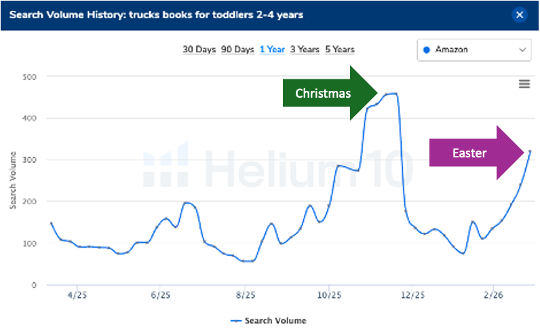
This pattern extends across nearly every major children’s book category: animals, dinosaurs, princesses, bedtime stories, early learning, and more. Easter functions as a demand multiplier because the underlying intent is gift-giving. Customers are not always shopping for “Easter books;” they are shopping for gifts that fit inside an Easter basket.
This is a critical strategic distinction. Publishers who focus only on books with bunnies, eggs, or religious themes are capturing only a portion of the available demand. The broader opportunity lies in positioning a wide range of children’s books as relevant Easter basket stuffers, regardless of whether the shopper uses the word “Easter” in their search.
Year-Over-Year Search Behavior and Amazon Influence
Recent Easter seasons have highlighted how dramatically search behavior can shift year over year, sometimes influenced by platform-level interventions. In 2025, the highest-volume Easter-related search term was “Easter basket essentials,” generating nearly 1M searches during the Easter season. In 2026, that same term did not appear in the top 100 variations and generated only around 500 searches.
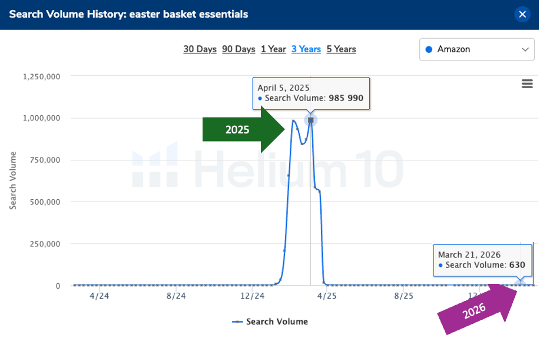
This shift was identified by the Amplify team within days through active Amazon monitoring, allowing for rapid pivots in keyword targeting, metadata optimization, and advertising strategy.
The likely explanation for the rise and fall of this term points to Amazon’s autosuggest feature. “Easter basket essentials” appears to have been artificially elevated as a forced first option in the autosuggest dropdown, despite not reflecting natural customer language.
A plausible explanation is that this was tied to Amazon’s internal effort to promote its Amazon Essentials brand by encouraging the use of the term “Essentials” across popular search queries. With thousands of ASINs under that brand, influencing customer behavior at the search level could have had widespread impact. However, the behavior did not persist. Customers did not adopt the phrasing organically, and by 2026, Amazon appears to have removed it from autosuggest prioritization, resulting in the collapse of search volume.
Another important year-over-year change occurred at the category level. In 2025, books were the second most clicked-on category for the search “Easter Basket Essentials,” and they were also the second most clicked category for “Easter Basket Stuffers.” This made books a critical focus for both metadata strategy and Amazon Ads targeting.
In 2026, books did not appear in the top three clicked-on categories for these searches. Instead, shopper attention shifted toward Jewelry, Toys, and Grocery. This underscores the importance of monitoring not just keyword volume, but also click distribution and competitive category dynamics when planning seasonal strategies.
Real-World Performance Across Publishers
Amplify Marketing Services has worked with over 50 publishers, many of whom produce children’s books that are well-suited for Easter baskets. Performance during the 2026 Easter season varied significantly. Some publishers experienced substantial growth in their most relevant titles, while others saw mixed results.
Easter seasonal performance is influenced by multiple factors, including:
Competition
Newly released seasonal titles entering the market
Competitors becoming more aggressive with advertising
Improvements in competitor metadata optimization
Brand Awareness
More established and recognizable brands tend to convert at higher rates due to existing trust
Metadata Optimization
Title optimization
Description formatting
Look Inside functionality
Backend keywords
Inventory & Investment
Inventory availability during peak demand
Time and budget invested both before and during the seasonal window
Ongoing effort required to build trust and authority with Amazon leading into the season
Amazon-Controlled Factors
Amazon’s discounting behavior, which can influence conversion rates
Promotional pricing and coupons (partially controllable by publishers)
Reviews & Social Proof
Lower star ratings compared to competitors
Fewer total reviews than competing titles
Additional factors include Amazon’s own discounting behavior, which can influence conversion rates, although publishers can partially offset this with promotions and coupons. Poor reviews, whether due to lower star ratings or fewer total reviews than competing titles, can further limit performance.
A Case Study in Non-Easter Book Success
One of the most compelling examples from the 2026 Easter season was the performance of Baby’s First Bible Stories, which consistently held the #1 position in the Children’s Easter Books category and ranked among the top 20 books overall on Amazon during the Easter period.
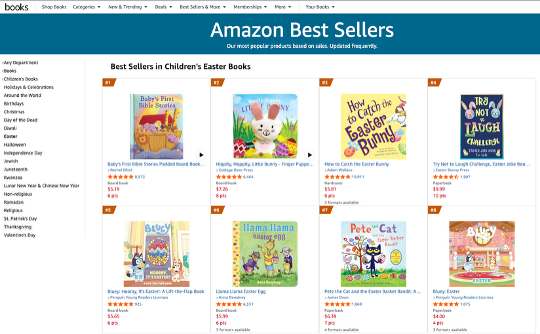
This book is not Easter-themed and does not feature a bunny or egg on the cover, yet it captured significant market share due to several key factors:
Aggressive Discounting
Amazon applied a 48% discount
Price dropped from $9.99 to approximately $5
Positioned the book in a strong impulse-buy range
Strong Social Proof
Nearly 9,000 reviews
4.9-star average rating
High trust and conversion potential
Seasonal Visual Alignment
Pastel-colored Noah’s Ark cover
Aesthetic aligns with Easter themes
Feels appropriate for Easter baskets despite not being holiday-specific
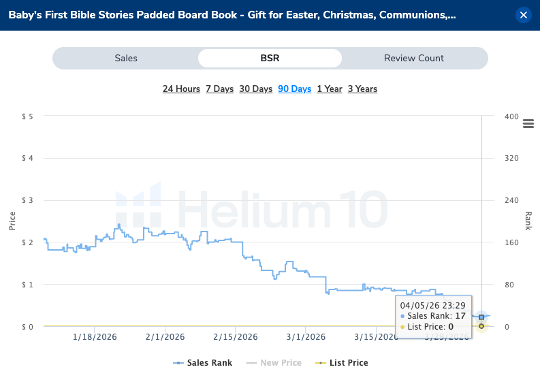
The book performed well across a wide range of search queries, including:
High-Intent Easter & Gift Searches
“baby easter basket stuffers”
“easter books for toddlers 1–3”
“baby easter”
Core Category Searches
“baby books”
“baby book”
Gift-Oriented Searches
“baby boy gifts”
“baby girl gifts”
“baby gifts”
Performance Takeaways
Ranks across a wide variety of relevant searches that most publishers would want their books to appear in
Reflects strong metadata execution
Likely supported by an effective advertising strategy
Demonstrates a combination of a strong product, strong positioning, and well-executed discoverability
Well done, Cottage Door Press!
Key Takeaways for Publishers and Authors
Easter represents a major opportunity that requires intentional planning and execution. Publishers should optimize metadata well ahead of the season, ensuring titles, descriptions, backend keywords, and visual presentation align with both Easter-specific and broader gift-related searches.
It is important to consider publishing strategies that include both directly Easter-related books and books that can be positioned as general Easter basket stuffers. Competitive analysis should inform both advertising targeting and metadata decisions.
Most importantly, publishers should recognize that Easter demand extends far beyond searches that include the word “Easter.” For most children’s book queries, it is the second-highest traffic period of the year. Capturing that demand requires thinking beyond holiday-specific content and positioning a wider catalog to meet gift-driven intent.
When strong content, optimized metadata, effective advertising, competitive pricing, and positive reviews align, Easter can become one of the most powerful seasonal drivers of children’s book sales, second only to Christmas in both scale and strategic importance.