How Much Should Book Publishers Invest in Amazon Ads—and What Return Can They Expect?
By Emily Albertelli, Senior Director of PPC Marketing, Amplify Marketing Services
One of the most common questions publishers ask us is also one of the hardest to answer:
If we invest more in Amazon advertising, how much growth should we expect in return?
After managing Amazon advertising across a wide range of publishers, catalogs, budgets, and market conditions, we have enough historical data to provide a useful benchmark.
Once a comprehensive Amazon advertising strategy has been built and optimized, we have consistently seen approximately $3 to $3.25 in year-over-year total sales growth for every $1 invested in Amazon Ads.
And there is an important distinction in that statement:
We aren't talking about ad-attributed sales or ROAS reported in the Amazon Ads console. We are measuring the advertising investment against total sales for those products as reported in Amazon Vendor Central, comparing their performance with the same period the previous year.
In other words, we're looking beyond the sales Amazon directly attributes to an ad and asking a bigger business question, “How much did total Amazon sales grow relative to what was invested in advertising?”
This distinction matters because the ultimate goal of Amazon advertising isn't simply to produce a low ACOS or high ROAS. It's to generate incremental sales that would not otherwise have occurred. For publishers, that means looking at whether advertising is contributing to growth in total sales—including both ad-attributed and organic sales—not simply how efficiently Amazon reports that the advertising converted.
Our Benchmark: $1 in Ad Spend → Approximately $3.25 in Total Sales Growth
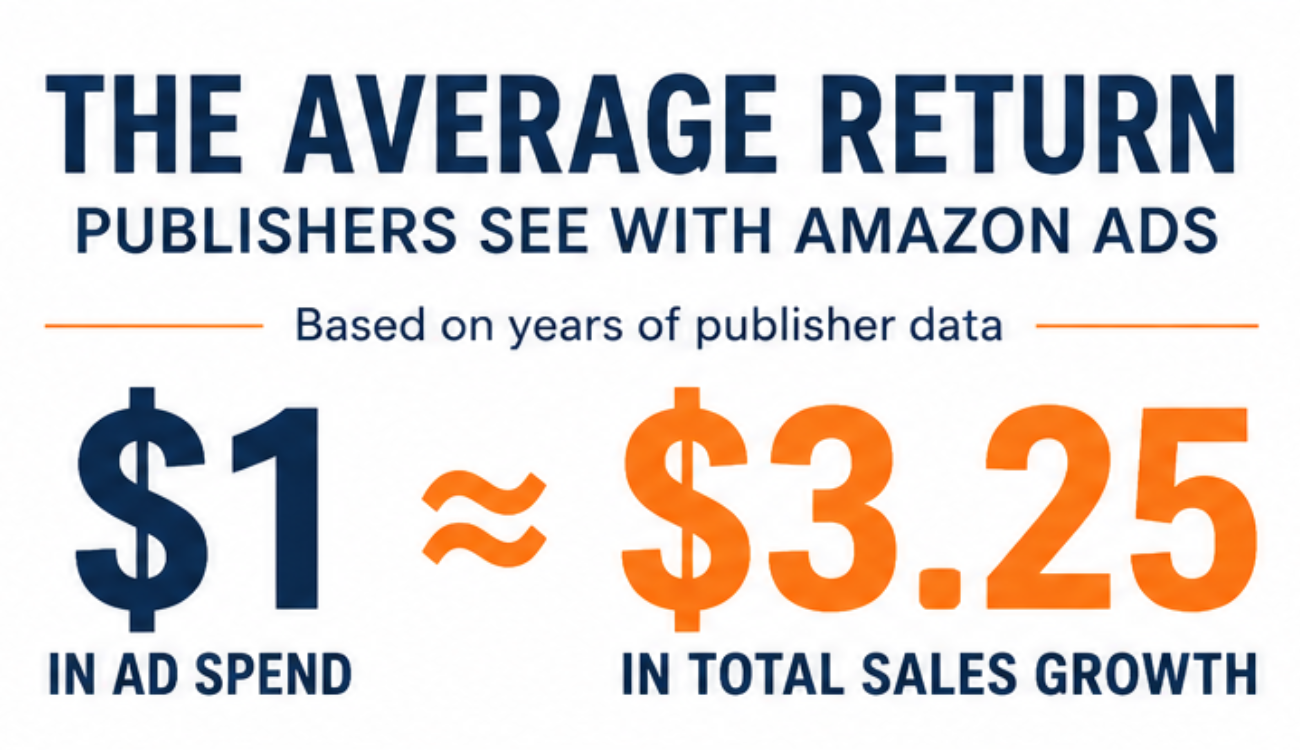
Across years of data, the most consistent relationship we have observed is approximately $3.25 in incremental year-over-year total sales growth for every $1 invested in Amazon advertising.
There are certainly exceptions.
We regularly see returns substantially higher than this. Under particularly favorable circumstances, total year-over-year sales growth can exceed 7 times the advertising investment.
That can happen when a publisher previously had little or no advertising in place, when a book or category has particularly strong momentum, or when seasonality and market demand create an unusually favorable opportunity.
But we don't use exceptional cases to establish our expectations.
Across different publishers, categories, budgets, and market conditions, approximately 3 to 3.25 times the advertising investment has been the much more consistent benchmark.
What Does That Look Like in Real Dollars?
Consider a group of products generating $1 million in annual Vendor Central sales.
| Amazon Ad Spend | % of Sales Invested | Typical YoY Sales Growth |
|---|---|---|
| $10,000 | 1% | ~$30,000–$32,500 |
| $30,000 | 3% | ~$90,000–$97,500 |
| $50,000 | 5% | ~$150,000–$162,500 |
The relationship also tends to scale surprisingly well.
A publisher investing a relatively small percentage of its Amazon revenue into advertising can still see a similar ratio of advertising investment to growth. The resulting dollar growth is simply smaller.
Likewise, significantly increasing the advertising investment can produce substantially greater total growth while maintaining a similar ratio—up to the point where the available market can no longer absorb additional advertising dollars at the same efficiency.
The Ultimate Goal of Amazon Ads Isn't a Low ACOS. It's Incremental Sales Growth.
ACOS and ROAS are important metrics for managing and optimizing Amazon advertising, but neither should be mistaken for the ultimate measure of success.
For a publisher, the real objective is incremental growth in total book sales—including both ad-attributed and organic sales.
It is possible to produce an extremely low ACOS or impressive ROAS without creating nearly as much incremental growth as those numbers might suggest.
For example, advertising against an author's name, a publisher's own titles, or other branded searches can generate excellent advertising metrics because those shoppers already have a high likelihood of purchasing the book. Similarly, an ad can generate attributed sales by paying for placement where a book has already earned strong organic visibility.
Those campaigns can serve valuable defensive and strategic purposes. But an attributed sale isn't necessarily an incremental sale. In some cases, advertising may simply receive credit for a purchase that was likely to happen anyway.
That's why optimizing an entire Amazon advertising strategy around achieving the lowest possible ACOS can be counterproductive.
A campaign that reaches new readers, expands a book's discoverability, or generates sales it otherwise would not have received may have a higher ACOS than a branded or defensive campaign. Yet it may be doing far more to grow the publisher's overall business.
The goal isn't to make the advertising dashboard look as efficient as possible. The goal is to use advertising to make total sales larger than they otherwise would have been.
This is why we evaluate advertising performance at two levels.
We use ACOS, ROAS, conversion rates, targeting performance, and other advertising metrics to make day-to-day optimization decisions. But to evaluate whether the overall investment is actually growing the business, we look beyond the Amazon Ads console and measure the change in total sales as reported in Vendor Central.
That includes the ad-attributed sales Amazon reports as well as the broader organic sales activity occurring alongside the advertising program.
Ultimately, the question isn't simply, “What ROAS did our ads report?” It's “How much additional total revenue did our advertising investment help generate?” That is the return we believe matters most.
A High ROAS Isn't the Same as Incremental Growth
A 6× advertising ROAS does not mean advertising increased total sales by 6× the ad investment.
ROAS measures the sales Amazon attributes to advertising. Some of those purchases may have occurred without the ad—particularly with branded, defensive, or other high-intent targeting.
Our growth benchmark measures something different: how much total Vendor Central sales changed relative to the amount invested in advertising.
The 5% Benchmark
The next question is usually: How much should we spend?
Again, there isn't one budget that's appropriate for every publisher. But our historical data has revealed another remarkably consistent benchmark.
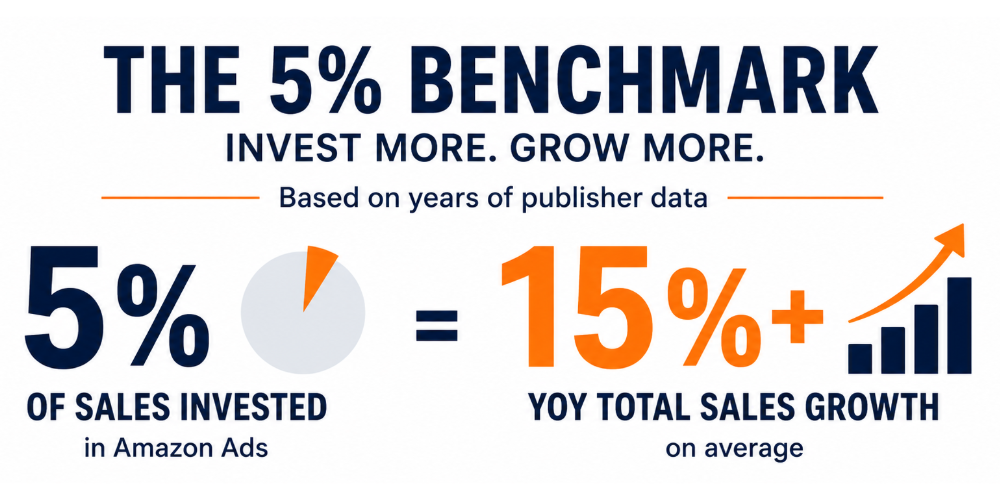
An Amazon advertising investment of approximately 5% of total Vendor Central sales has been a particularly productive level for generating meaningful, sustainable growth.
At that investment level, the math is straightforward. If approximately 5% of sales is reinvested into Amazon advertising and the publisher generates approximately 3 to 3.25 times that investment in incremental year-over-year growth, the result is typically about 15% or more in total year-over-year sales growth.
5% of Revenue Invested in Ads → Approximately 15%+ YoY Total Sales Growth
For example, a publisher generating $2 million in Vendor Central sales would invest approximately $100,000—or 5%—in Amazon Ads.
At our historical benchmark, that level of advertising investment would correspond with approximately $300,000 to $325,000 in incremental year-over-year sales growth.
That doesn't mean every publisher should automatically spend 5%.
It gives us a useful starting point for determining what level of investment aligns with a publisher's goals.
What If You Want to Spend Less?
Some publishers spend substantially less than 5% of their Amazon revenue on advertising.
We've worked with publishers investing below 1%, particularly when their objective is to maintain a relatively conservative advertising program while still supporting discoverability, consistency, and incremental growth.
Our data indicates that the relationship between ad spend and growth can remain relatively consistent even at these lower investment levels.
The difference is scale.
If a publisher reinvests 1% of its Amazon sales into advertising rather than 5%, it may still generate an attractive return on those advertising dollars—but the impact on total company growth will naturally be much smaller.
For publishers primarily interested in maximizing efficiency rather than accelerating growth, that can be an entirely reasonable strategy.
What About Spending More Than 5%?
There are also situations where spending significantly more than 5% makes sense.
Publishers may choose to invest more aggressively when they are:
Trying to gain market share
Entering a new category or market
Capitalizing on a growing trend
Launching strategically important titles
Building awareness for an author, series, or publishing brand
Prioritizing growth over short-term advertising efficiency
Increasing the investment can continue producing incremental growth, but there is eventually a practical ceiling.
Every book, category, and market has a finite amount of relevant advertising inventory and consumer demand. At some point, additional advertising dollars can't be deployed while maintaining the same ACOS and overall efficiency.
The goal isn't simply to spend more.
The goal is to find the highest productive level of investment the market can efficiently support.
What If Sales Were Already Declining?
One of the more interesting findings in our historical data is that these results aren't limited to products that were already growing.
We have seen advertising produce meaningful year-over-year improvement even when the same products had previously been declining.
That's particularly important for publishers with large backlists.
The question isn't necessarily whether a book currently has momentum. The question is whether there is sufficient consumer demand and advertising opportunity to profitably increase its visibility and sales.
A well-structured Amazon advertising program can often create new momentum for products that weren't generating it on their own.
So, How Much Should a Publisher Invest in Amazon Ads?
Rather than starting with an arbitrary monthly advertising budget, we recommend looking at advertising investment in relation to total Amazon sales.
As a general framework based on what we have observed:
Around 1% of Vendor Central sales represents a relatively conservative advertising investment. It can still generate incremental growth while keeping advertising expense low.
Around 3% represents a more meaningful investment in growth and gives advertising considerably more opportunity to influence overall sales.
Around 5% has historically been an especially productive level across the accounts we manage, frequently corresponding with total year-over-year sales growth of approximately 15% or more.
Above 5% can make sense for publishers pursuing aggressive growth, market share, new opportunities, or brand development, provided the available market can absorb the additional investment efficiently.
The right number ultimately depends on the publisher's catalog, existing sales, objectives, margins, seasonality, competitive environment, and appetite for growth.
A Benchmark, Not a Guarantee
No advertising investment comes with a guaranteed return.
Individual results can be affected by existing advertising activity, category demand, seasonality, pricing, retail availability, competition, title mix, organic momentum, and many other factors.
The figures presented here are therefore not a promise that every dollar invested will produce exactly $3.25 in incremental sales.
They are a benchmark drawn from what we have consistently observed across years of managing Amazon advertising for publishers.
It gives publishers a way to think about Amazon Ads as an investment in total sales growth—rather than an exercise in producing the best possible advertising metrics.
A low ACOS or high ROAS can be valuable, but those numbers are means to an end. The ultimate measure of a successful Amazon advertising program is whether the investment is helping generate incremental growth in total sales.
That's the outcome we believe publishers should optimize toward.
What Could the Right Amazon Advertising Investment Produce for Your Catalog?
Amplify Marketing Services works with publishers to evaluate their existing Amazon sales, advertising investment, catalog opportunities, and growth objectives.
By looking at both Amazon Ads performance and total Vendor Central sales, we can help determine where your current investment falls relative to these benchmarks—and how much additional opportunity may exist within your catalog.